
Adam Lay Ybounden
This is my modern English translation of the early English rhyming poem "Adam Lay Ybounden" and its sister poems "I Have a Gentil Cok," "I Syng of a Mayden" and "I Have a Yong Suster."

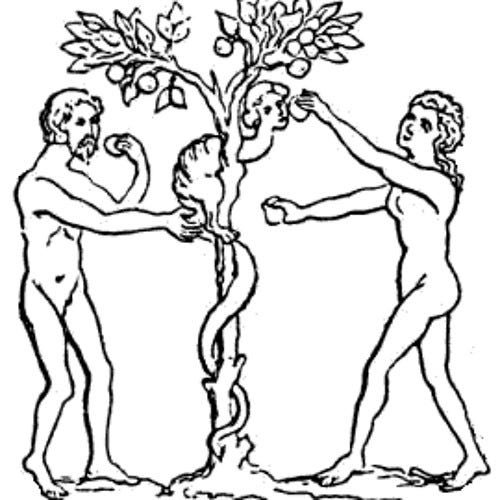
Adam Lay Ybounden
Adam Lay I-bounden
Adam Lay I-bowndyn
"Adam Lay Ybounden" is an early English rhyming poem that dates to the early 15th century, circa 1400 AD. Originally a song, the poem's musical setting did not survive, but the lyrics have been set to new music by modern composers like Boris Ord. The poem is based on the Biblical story of Adam, Eve, the Garden of Eden, the "forbidden fruit" and the "fall." However, the poet took an optimistic view, saying that the eating of the forbidden apple ended well, thanks to Mary and her son Jesus.
I have also included my translations of poems that appear on the same page of the Sloane Manuscript: "I have a gentil cok," "I syng of a mayden" and ""I have a yong suster."
Adam Lay Ybounden
(anonymous Medieval English Lyric, circa early 15th century AD)
loose translation/interpretation by Michael R. Burch
Adam lay bound, bound in a bond;
Four thousand winters, he thought, were not too long.
And all was for an apple, an apple that he took,
As clerics now find written in their book.
But had the apple not been taken, or had it never been,
We'd never have had our Lady, heaven's queen.
So blesséd be the time the apple was taken thus;
Therefore we sing, "God is gracious!"
The "four thousand winters" refers to the belief that Adam was bound in Limbo for four thousand years before being released by Jesus Christ.
Here is the original poem in one of its ancient forms:
Adam lay i-bounden, bounden in a bond;
Foure thousand winter thought he not too long.
And all was for an apple, an apple that he took,
As clerkes finden written in theire book.
Ne hadde the apple taken been, the apple taken been,
Ne hadde never our Lady aye been heavene queen.
Blessed be the time that apple taken was,
Therefore we moun singen, “Deo gracias!”
I Have a Gentil Cok
circa early 15th century
loose translation/interpretation by Michael R. Burch
I have a gentle cock
who crows in the day;
he bids me rise early,
my matins to say.
I have a gentle cock,
he comes with the great;
his comb is of red coral,
his tail of jet.
I have a gentle cock,
kind and laconic;
his comb is of red coral,
his tail of onyx.
His legs are pale azure,
so gentle and so slender;
his spurs are silver-white,
so pretty and so tender!
His eyes are like fine crystal
set deep in golden amber,
and every night he perches
in my lady’s chamber.
I Syng of a Mayden
(anonymous Medieval English Lyric, circa early 15th century AD)
loose translation/interpretation by Michael R. Burch
I sing of a maiden
That is matchless.
The King of all Kings
For her son she chose.
He came also as still
To his mother's breast
As April dew
Falling on the grass.
He came also as still
To his mother's bower
As April dew
Falling on the flower.
He came also as still
To where his mother lay
As April dew
Falling on the spray.
Mother and maiden?
Never one, but she!
Well may such a lady
God's mother be!
Here is the original poem in one of its ancient forms:
I sing of a maiden (virgin)
That is makeles: (matchless / mateless / spotless)
King of alle kinges
To her sone she chees. (for her son she chose)
He cam also stille (He came as silently)
Ther his moder was (where his mother was)
As dewe in Aprille
That falleth on the gras.
He cam also stille
To his modres bowr (mother's bower, perhaps meaning both bedroom and leafy nest)
As dewe in Aprille
That falleth on the flowr.
He cam also stille
Ther his moder lay
As dewe in Aprille
That falleth on the spray (blossom and/or budding twig)
Moder and maiden (Mother and virgin)
Was nevere noon but she:
Well may swich a lady (such a lady)
Godes moder be.
I Have a Yong Suster
(Anonymous Medieval English Riddle-Poem, circa 1430 AD)
Modern English loose translation/interpretation by Michael R. Burch
I have a yong suster / I have a young sister
Fer biyonde the see; / Far beyond the sea;
Manye be the druries / Many are the keepsakes
That she sente me. / That she sent me.
She sente me the cherye / She sent me the cherry
Withouten any stoon, / Without any stone;
And so she dide the dove / And likewise the dove
Withouten any boon. / Without any bone.
She sente me the brere / She sent me the briar
Withouten any rinde; / Without any skin;
She bad me love my lemman / She bade me love my lover
Withoute longinge. / Without longing.
How sholde any cherye / But how can any cherry
Be withoute stoon? / Be without stone?
And how sholde any dove / And how can any dove
Be withoute boon? / Be without bone?
How sholde any brere / How can any briar
Be withoute rinde? / Be without skin?
How sholde I love my lemman / And can one love
Withoute longinge? / Without longing?
Whan the cherye was a flowr, / When the cherry was a flower,
Thanne hadde it no stoon; / Then it had no stone;
Whan the dove was an ey, / When the dove was an egg,
Thanne hadde it no boon. / Then it had no bone.
Whan the brere was unbred, / When the briar was unborn,
Thanne hadde it no rinde; / Then it had no skin;
Whan the maiden hath that she loveth, / And when a maiden has her mate,
She is withoute longinge. / She is without longing!
TRANSLATOR'S NOTES
by Michael R. Burch
That is a wickedly funny ending! Another way to phrase it would be: "When a maiden finally has the man she wants / she loses her desire!" There are quite a number of different versions of the poem. This is my favorite version. If the experts are correct, the poem could have been written by minstrels to be performed as they wandered from village to village, perhaps being fed in return for providing entertainment. The different versions of the poem/song could be explained by different minstrels "tinkering" with the lyrics, or by people who danced to the song remembering it imperfectly.
DATING THE POEM
The oldest extant copy of the poem can be found in the British Library, in the Sloane Manuscript, reference number 2593. This is a collection of songs and carols dating to the fifteenth century. The date most commonly associated with the poem is 1430 AD. I believe this is probably because the poem is considered to be antecedent to "The Devil's Nine Questions," which has been dated to around 1450.
INTERPRETATION(S)
One interpretation of the poem is erotic, but another possibility is that an older sister is communicating with her younger sister about the lack of passion in her marriage.
In one version of the "I Have a Yong Suster," the briar becomes "without branch or leaf" and the speaker is instructed to love "without grief." But that weakens the ending, in my opinion. In his excellent and informative book An Outline of English Literature, Pat Rogers called the poem a "haunting riddle-chant," and I agree about its haunting nature. I hope I have preserved that haunting quality in my translation. A similar haunting poem from the same era is the mysterious "Corpus Christi Carol," which begins "Lully, lulley, lully, lulley, / The falcon hath born my mak away." (With "mak" meaning "mate.") ― Michael R. Burch
THE POEM AND SONG IN POPULAR CULTURE
"I Have a Yong Suster" may be related to the "Cherry-Tree Carol," which appears in the famous Child Ballads (number 54), a collection of early English ballads.
The poem apparently influenced nineteenth-century nursery rhymes and songs with titles like "Perrie, Merrie, Dixie, Dominie," "I Have Four Sisters Beyond the Sea," "I Had Four Brothers Over the Sea," and "My True Love Lives Far from Me," in which an overseas sweetheart sends enigmatic gifts.
The popular song "I Gave My Love a Cherry" or "The Cherry Song" is quite obviously related to "I Have a Yong Suster" and shares very similar lyrics and structure, but with the maiden being replaced by a baby with "no crying" because it's sleeping by the end of the lullaby. Burl Ives recorded "The Cherry Song" as "The Riddle Song" in 1941. "The Cherry Song" has since been recorded with various titles by Joan Baez, Sam Cooke, Duane Eddy (instrumental), Tennessee Ernie Ford, Ronnie Hawkins (an especially tender and lovely performance), Sonny James, Grandpa Jones, Peggy Lennon of the Lennon Sisters, Pete Seeger and Doc Watson, among others. The song was also featured in the movie Animal House, when a toga-wearing Bluto (John Belushi) finds a guitarist (singer-songwriter Stephen Bishop) serenading a rapt group of female co-eds on a staircase. Bluto grabs the guitar, smashes it to pieces, then mumbles "Sorry." (But then the endlessly annoying Bishop did tend to go "On and On," if you'll pardon the pun.) "The Riddle Song" was also featured on an episode of The Simpsons in which Homer serenaded Marge with a line from the song: "I gave my love a chicken, it had no bones. Mmm … chicken!" Josh White also performed the song in the 1949 movie The Waking Hills. All the performances mentioned can be found free on YouTube.
The popular song "The Twelfth of Never" was based on "The Cherry Song" with lyrics like "I'll love you till the poets run out of rhyme." The song was first recorded by Johnny Mathis and reached #9 in the US. It was covered by Cliff Richard and reached #8 in the UK. It was then covered by Donny Osmond and reached #1 in the UK and #8 in the US. "The Twelfth of Never" has been covered by Elvis Presley, Olivia-Newton John, Nina Simone, Barry Gibb, Cher, Tammy Wynette, Dolly Parton, Jeff Buckley, Oliver, The Chi-Lites, Andy Williams, Slim Whitman, Glen Campbell, Roger Miller, Johnny Nash and Barry Manilow, among others.
OTHER TRANSLATIONS
The following are links to other translations by Michael R. Burch. "Wulf and Eadwacer" may be the oldest extant poem in the English language written by a female poet. "Sweet Rose of Virtue" is a modern translation of a truly great poem by the early Scottish master William Dunbar. "How Long the Night" is one of the very best Anglo Saxon lyric poems. "Caedmon's Hymn" may be the oldest poem in the English language.
The Seafarer
Wulf and Eadwacer
Adam Lay Ybounden
Sweet Rose of Virtue
How Long the Night
Caedmon's Hymn
Anglo-Saxon Riddles and Kennings
Bede's Death Song
The Wife's Lament
Deor's Lament
Lament for the Makaris
I vote for lemman being reintroduced into our working vocabularies.