
Bertolt Brecht Translations
These are my English translations of poems Bertolt Brecht wrote while on the run from the Nazis after Hitler assumed power in Germany. I have also translated several Brecht epigrams and quotes.

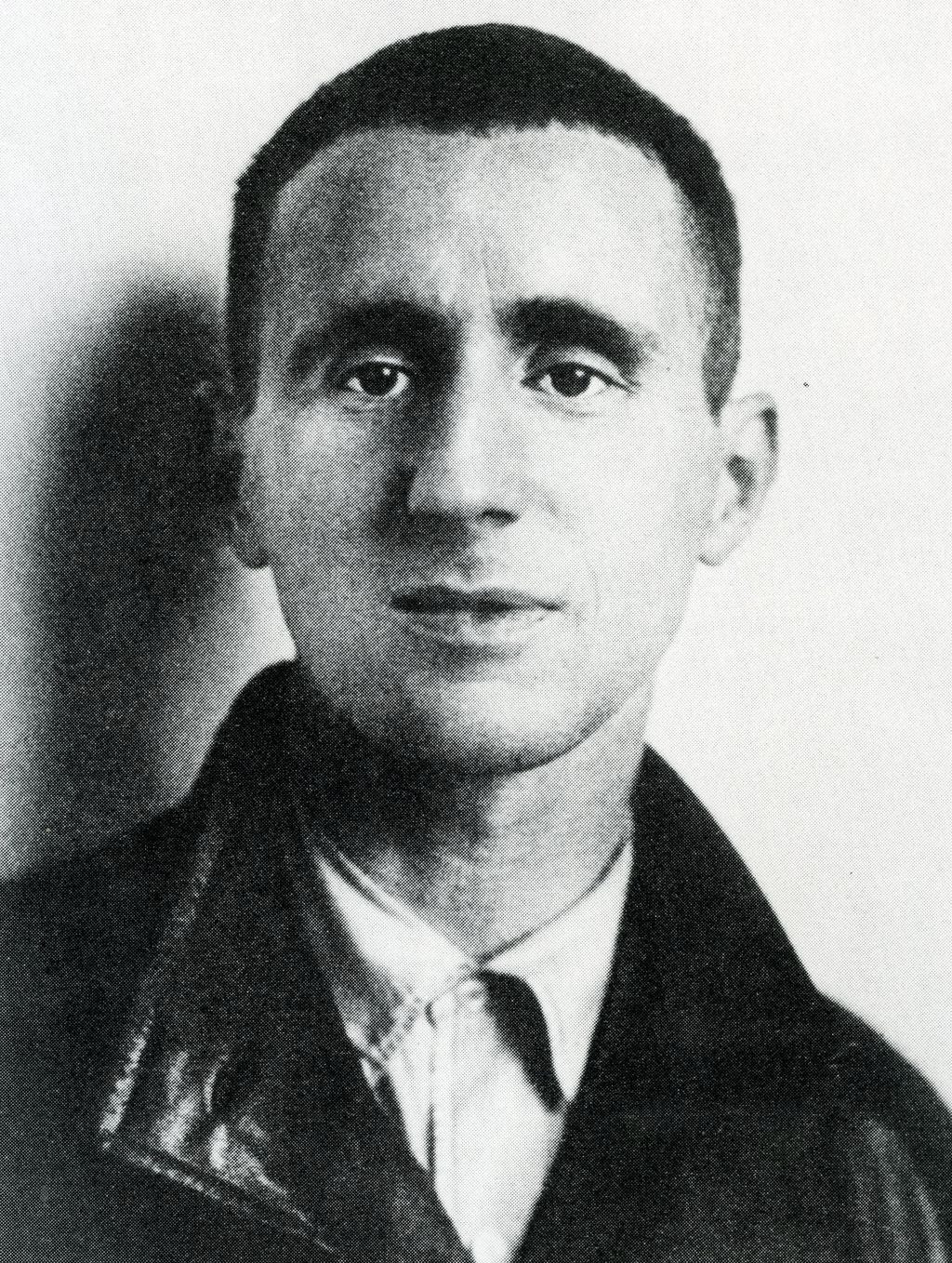
Bertolt Brecht [1898-1956] was a major German poet, playwright, novelist, humorist, essayist, theater director and songwriter. He was also a highly influential pioneer of modern epic theater, or dialectical theater, with its "alienation effect" (also known as the "distancing effect" or "estrangement effect").
Brecht is highly regarded today for his poetry, for plays such as Antigone, St. Joan of the Stockyards, Life of Galileo, Mother Courage and Her Children, The Threepenny Opera, Edward II, Baal, In the Jungle and Drums in the Night, and for his lyrics to the song "Die Moritat von Mackie Messer" ("Mack the Knife"), which became a number one hit for Bobby Darin.
Brecht fled Germany in 1933, after Hitler assumed power. A number of Brecht's poems were written from the perspective of a man who sees his country becoming increasingly fascist, xenophobic and militaristic. For instance, the first poem below was written by Brecht about the Nazi book burnings orchestrated by Hitler's propaganda-meister Joseph Goebbels. The Nazis burned the books of writers they considered to be "decadent," including those of Thomas Mann, Ernest Hemingway and even Helen Keller. Also among the books burned were those of the great German-Jewish poet Heinrich Heine, who in his 1820-1821 play Almansor accurately predicted, “Dort, wo man Bücher verbrennt, verbrennt man am Ende auch Menschen." ("Where they burn books, they will also ultimately burn people.")
Die Bücherverbrennung (“The Burning of the Books”)
by Bertolt Brecht
loose translation/interpretation by Michael R. Burch
When the Regime
commanded the unlawful books to be burned,
teams of dull oxen hauled huge cartloads to the bonfires.
Then a banished writer, one of the best,
scanning the list of excommunicated texts,
became enraged — he'd been excluded!
He rushed to his desk, full of contemptuous wrath,
to write fiery letters to the incompetents in power —
Burn me! he wrote with his blazing pen —
Haven't I always reported the truth?
Now here you are, treating me like a liar!
Burn me!
I take this poem to be Brecht's actual response to Nazi book burnings. Burning a writer's words is like burning him alive at the stake—the fate of many truthtellers at the hands of conformists. What do fascists fear? They fear the truth. So I imagine Brecht to be saying, "I've always reported the truth, so burn my words and burn me in the process!" But of course his truthful words have outlived and vastly outshone his enemies' lies. It is possible that he was thinking of some other banished writer, but I suspect that Brecht had himself in mind. He was, after all, that good.
Parting
by Bertolt Brecht
loose translation/interpretation by Michael R. Burch
We embrace;
my fingers trace
rich cloth
while yours encounter only moth-
eaten fabric.
A quick hug:
you were invited to the gay soiree
while the minions of the "law"
relentlessly pursue me.
We talk about the weather
and our eternal friendship's magic.
Anything else would be too bitter,
too tragic.
This is another poem that I take literally. I can easily imagine Brecht meeting a friend who remained in favor with the authorities, while he had been reduced to poverty and clandestine flight for resisting. Thus, they exchange a quick hug and a little light talk about the weather, because anything else would be "too tragic." Brecht had begun his resistance at age 16, during World War I, when he was almost expelled from school for arguing that only an empty-headed person could be persuaded to die for his country. Later, he did indeed "part" with Germany, fleeing his country in 1933 after Hitler rose to power.
The Mask of Evil
by Bertolt Brecht
loose translation/interpretation by Michael R. Burch
A Japanese carving hangs on my wall —
the mask of an ancient demon, limned with golden lacquer.
Not unsympathetically, I observe
the forehead's bulging veins,
the tremendous strain
such malevolence requires.
I can easily imagine this poem being written about men like Hitler and the Nazis. It would, indeed, seem to require a great deal of effort and straining to be so evil. The demonic mask limned with golden lacquer reminds me of Trump gold-plating his freakin' toilets!
Radio Poem
by Bertolt Brecht
loose translation/interpretation by Michael R. Burch
You, little box, held tightly
to me
during my escape,
so that your delicate tubes do not break;
carried from house to house, from ship to train,
so that my enemies may continue communicating with me
by land and by sea
and even in my bed, to my pain;
the last thing I hear at night, the first when I arise,
recounting their many conquests and my cares,
promise me not to go silent in a sudden
surprise.
Once again, I find myself reading Brecht's poem literally. I can imagine him fleeing the Nazis with a radio in his possession, using it to receive the news of their conquests as his litany of cares mounted. I felt something similar when I listened to the news of Trump's victory in the 2016 election. I felt shock, horror, revulsion and dread. How are such things possible? How can anyone vote such men into power?
The original German version of “Mack the Knife” was much darker than the English version.
Mack the Knife
by Bertolt Brecht
translation/interpretation by Michael R. Burch
And the shark has teeth,
he bares them in his face.
And Macheath has a knife,
yet no one sees a trace.
And the shark’s fins
gleam bright red when he sheds blood.
But Mack the Knife
hides his crimes beneath a glove.
By the waters of the Thames
suddenly people duck down,
fearing neither plague nor cholera,
but whisper: “Mack’s around.”
On a beautiful, sky-blue Sunday
a dead man lies on the Strand
as someone slips ’round the corner:
Mack the Knife with shiv in hand.
And Schmul Meier’s never been found,
like many a rich man,
since Mack the Knife has his money,
but left no evidence.
Jenny Towler was found
with a knife in her breast,
and yet there sits Mack the Knife,
smiling, on an embankment.
And where is Alfons Glite, the cabbie?
Will he ever see daylight again?
Who the hell could ever know,
since Mack the Knife silenced his kin.
And that great fire in Soho,
the one that killed seven kids and an old man?
In the crowd was Mack the Knife,
but “No one knows nothing.”
And the underage widow
whose husband’s death was such a surprise,
woke up, defiled.
Mack, what was your price?
“Mack the Knife” came to the U.S. in 1933 with the premiere of The Threepenny Opera, but it wasn’t a hit until 1952, when Leonard Bernstein conducted a version with English lyrics by Marc Blitzstein.
Bertolt Brecht Epigrams and Quotations
Everyone chases the way happiness feels,
unaware how it nips at their heels.
— loose translation/interpretation by Michael R. Burch
The world of learning takes a crazy turn
when teachers are taught to think and discern!
— loose translation/interpretation by Michael R. Burch
Unhappy, the land that lacks heroes.
— loose translation/interpretation by Michael R. Burch
Hungry man, reach for the book:
it's a hook,
a harpoon.
— loose translation/interpretation by Michael R. Burch
Because things are the way they are,
things can never stay as they were.
— loose translation/interpretation by Michael R. Burch
War is like love; true ...
it finds a way through.
— loose translation/interpretation by Michael R. Burch
What happens to the hole
when the cheese is no longer whole?
— loose translation/interpretation by Michael R. Burch
It's easier to rob by setting up a bank
than by threatening the poor clerk.
— loose translation/interpretation by Michael R. Burch
Do not fear death so much, or strife,
but rather fear the inadequate life.
— loose translation/interpretation by Michael R. Burch
Alternate Translations
The Mask of Evil (II)
by Bertolt Brecht
loose translation/interpretation by Michael R. Burch
A Japanese carving hangs on my wall —
the mask of an ancient demon, limned with golden lacquer.
Not altogether unsympathetically, I observe
the bulging veins of its forehead, noting
the grotesque effort it takes to be evil.
Holocaust Poetry translations by Michael R. Burch:
Miklós Radnóti
Ber Horvitz
Paul Celan
Primo Levi
Wladyslaw Szlengel
Saul Tchernichovsky
The HyperTexts
These pieces make me think that
“The pen is mightier than the sword” (Bulwer-Lytton, 1839).
Speaking of your substack as a whole I love the poetry and so appreciate your curation