
Distant Moon
Fukuda Chiyo-ni wrote a number of marvelous haiku about our planet's mysterious companion, the distant moon...

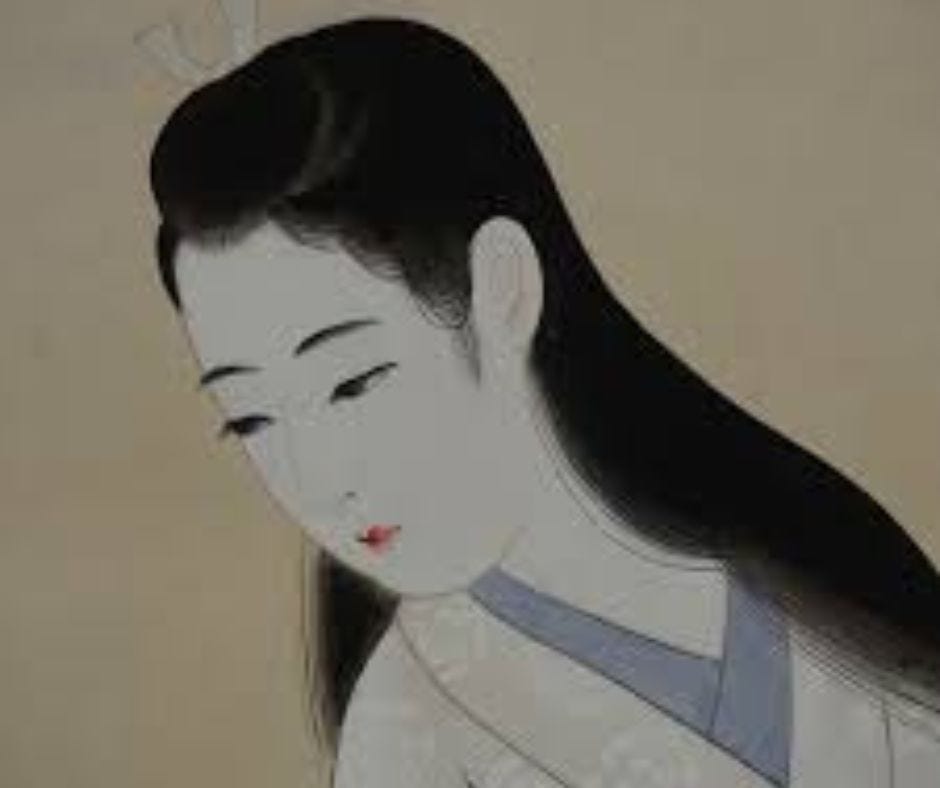
The eight autumn moon translations are dedicated to Stephen I. Hsu, who suggested the Chiyo-ni poems to me.
Walking, walking
toward the autumn moon,
never the nearer.
—Fukuda Chiyo-ni, loose translation/interpretation by Michael R. Burch
Bright autumnal moon,
but no matter how far I walked,
unreachable.
—Fukuda Chiyo-ni, loose translation/interpretation by Michael R. Burch
Bright autumnal moon,
but no matter how far I walked,
distant beyond my grasp.
—Fukuda Chiyo-ni, loose translation/interpretation by Michael R. Burch
Here, “grasp” in both the sense of touch and understanding.
I walk and walk
toward the autumn moon,
yet it remains forever distant.
—Fukuda Chiyo-ni, loose translation/interpretation by Michael R. Burch
Bright moon ...
walking, walking ...
forever distant
—Fukuda Chiyo-ni, loose translation/interpretation by Michael R. Burch
The original Chiyo-ni poem:
meigetsu ya: "bright moon" or "harvest moon" or "autumn moon"
ittemo ittemo: literally "walking, walking" or "however far I walk" or "no matter how much I walk"
yoso no sora: "distant sky" or "unknown sky" or "another's sky"
The bright autumn moon
even for those we keenly miss
shines just as full.
The bright autumn moon
even for those far from us
shines just as full.
The bright autumn moon
even for those far from us
seems just as close.
meigetsu ya: "bright moon" or "harvest moon"
rusu no hito ni mo: "for those far away"
maru nagara: "while round" or perhaps "remains round/full"
Fukuda Chiyo-ni (1703-1775), also known as Kaga no Chiyo and Kaga Chiyome, was a Japanese poet, painter and calligrapher of the Edo period. She began writing haiku at age seven and by age seventeen was popular throughout Japan. At age 52 she became a Buddhist nun, shaved her head, adopted the name Soen (“Escape”), and took up residence in a temple.
Her death poem:
Having seen the moon
I can bid this planet
farewell.
—Fukuda Chiyo-ni, loose translation/interpretation by Michael R. Burch
tsuki mo mite ware wa kono yo o kashiku kana
These are other haiku about the moon and moonflowers…
Leaves
like crows’ shadows
flirt with a lonely moon.
Fukuda Chiyo-ni, loose translation/interpretation by Michael R. Burch
At the sight of the distant moon
silence enters the heart.
—Fukuda Chiyo-ni, loose translation/interpretation by Michael R. Burch
With the waning moon
silence enters the heart.
—Fukuda Chiyo-ni, loose translation/interpretation by Michael R. Burch
The moon settled
in a flower-strewn stream ...
—Fukuda Chiyo-ni, loose translation/interpretation by Michael R. Burch
The moon
a morning blur
amid cherry blossoms
—Fukuda Chiyo-ni, loose translation/interpretation by Michael R. Burch
tsukikage mo tatazumu hana no asaborake
Illuminating
my fishing line:
the midsummer moon.
—Fukuda Chiyo-ni, loose translation/interpretation by Michael R. Burch
tsurizao no ito ni sawaru ya natsu no tsuki
Returning
from moon-viewing:
we humans, voiceless.
—Fukuda Chiyo-ni, loose translation/interpretation by Michael R. Burch
meigetsu ni kaerite hanasu koto wa nashi
The harvest moon
illuminates these snowdrifts
I trample.
—Fukuda Chiyo-ni, loose translation/interpretation by Michael R. Burch
meigetsu ya yuki fumiwakete ishi no oto
How contentedly they snore
in the boondocks:
full moon
—Fukuda Chiyo-ni, loose translation/interpretation by Michael R. Burch
uramachi no ibiki akarushi kyo no tsuki
Moonflowers blossoming:
a woman’s nakedness.
—Fukuda Chiyo-ni, loose translation/interpretation by Michael R. Burch
Moonflowers:
a woman glows
as she disrobes
—Fukuda Chiyo-ni, loose translation/interpretation by Michael R. Burch
Pausing between clouds
the moon rests
in the eyes of its beholders
― Matsuo Basho, loose translation/interpretation by Michael R. Burch
This world?
Moonlit dew
flicked from a crane’s bill.
— Eihei Dogen Kigen, loose translation/interpretation by Michael R. Burch
Full moon—
my ramshackle hut
is an open book.
―Kobayashi Issa, loose translation/interpretation by Michael R. Burch
Since I'm left here alone,
I'll make friends with the harvest moon.
―Yosa Buson, loose translation/interpretation by Michael R. Burch
We cannot see the moon
and yet the waves still rise
―Masaoka Shiki, loose translation/interpretation by Michael R. Burch
Watching wan moonlight
illuminate trees,
my heart also brims,
overflowing with autumn.
—Ono no Komachi, loose translation/interpretation by Michael R. Burch
The thief missed it:
the moon
bejeweling my window.
—Ryokan, loose translation/interpretation by Michael R. Burch
Once again
the melon-cool moon
rises above the rice fields.
—Tanko, loose translation/interpretation by Michael R. Burch
The moon so bright
a wandering monk carries it
lightly on his shoulder.
—Matsuo Basho, loose translation/interpretation by Michael R. Burch
Forbearing the night
with its growing brilliance:
the summer moon.
—Tsukioka Yoshitoshi, loose translation/interpretation of his jisei (death poem) by Michael R. Burch
Oh, brilliant moon
can it be true
that even you
must rush off, late
for some date?
― Kobayashi Issa, loose translation/interpretation by Michael R. Burch
Oh, brilliant moon
can it be true that even you
must rush off, tardy?
― Kobayashi Issa, loose translation/interpretation by Michael R. Burch
By such pale moonlight
even the wisteria's fragrance
seems distant.
—Yosa Buson, loose translation/interpretation by Michael R. Burch
Wild geese take flight,
gliding low along the railroad tracks
in the moonlight.
―Masaoka Shiki, loose translation/interpretation by Michael R. Burch
Having been summoned,
I say farewell
to my house beneath the moon.
—Takuchi, loose translation/interpretation by Michael R. Burch
The night is clear;
the moon shines quietly;
the wind strums the trees like lyres …
but when I’m gone, who the hell will hear?
Farewell!
—Higan Choro aka Zoso Royo, loose translation/interpretation by Michael R. Burch
Otagaki Rengetsu (1791-1875) was a poet, potter, painter, calligrapher and Buddhist nun.
Fearing the moon
sees my past,
I cast my eyes downward.
—Otagaki Rengetsu, loose translation/interpretation by Michael R. Burch
Even if a thought vanishes,
it may reignite
like a firefly in a distant field.
—Otagaki Rengetsu, loose translation/interpretation by Michael R. Burch
Even if a thought vanishes,
it may reappear
like a firefly in a distant field.
—Otagaki Rengetsu, loose translation/interpretation by Michael R. Burch
Drifting like white clouds
from horizon to horizon,
the mysterious heart.
—Otagaki Rengetsu, loose translation/interpretation by Michael R. Burch
As I await my absent beloved
the moon through the pines and the wind
increase my longing.
—Otagaki Rengetsu, loose translation/interpretation by Michael R. Burch
An obese firefly
flits by
flickering, flickering
—Otagaki Rengetsu, loose translation/interpretation by Michael R. Burch
The nightingale
eyes my hut
critically
—Kobayashi Issa, loose translation/interpretation by Michael R. Burch
When I’m gone
I want you to guard my gravestone,
vigilant cricket
—Kobayashi Issa, loose translation/interpretation by Michael R. Burch
Don’t trample
the dew-drops,
cricket!
—Kobayashi Issa, loose translation/interpretation by Michael R. Burch
The fluttering butterfly
dances through this hopeless world.
—Kobayashi Issa, loose translation/interpretation by Michael R. Burch
Knowing the bell
tolls our days:
eventide
—Kobayashi Issa, loose translation/interpretation by Michael R. Burch
The flickering
of soon-to-die
fireflies
—Kawabata Bosha, loose translation/interpretation by Michael R. Burch
Protect us from silence:
strike the gong again,
lookout.
—Hara Sekitei, loose translation/interpretation by Michael R. Burch