
Gilgamesh
These are two poems I wrote "under the influence" of the world's first great work of literature: the ancient Sumerian "Epic of Gilgamesh."

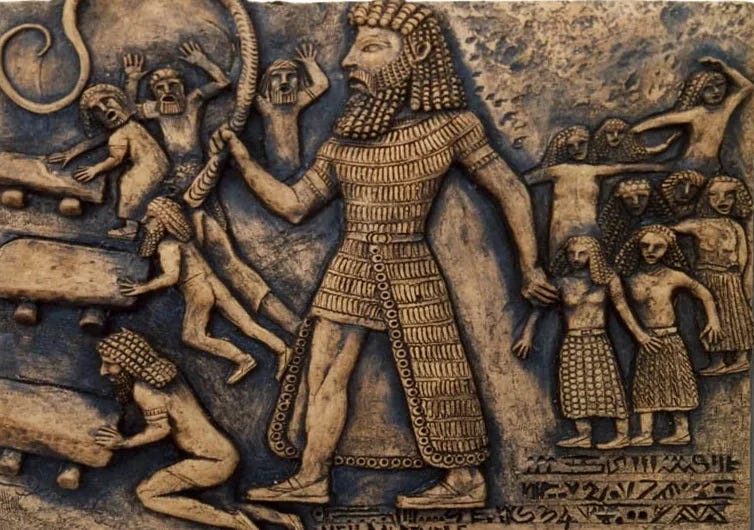
The Epic of Gilgamesh is an ancient Sumerian epic poem, written by an anonymous author or authors, circa 2285 BC. These are two poems I wrote, hoping to capture enough of the sense and mystery of the original, to encourage readers to “take the plunge” and read this ancient masterpiece. Louise Bogan’s “After the Persian” is another poem in this genre, so we have three tips of the cap to the world’s first great work of literature here.
He Lived: Excerpts from "Gilgamesh"
loose translation/interpretation by Michael R. Burch
I.
He who visited hell, his country's foundation,
Was well-versed in mysteries' unseemly dark places.
He deeply explored many underworld realms
Where he learned of the Deluge and why Death erases.
II.
He built the great ramparts of Uruk-the-Sheepfold
And of holy Eanna. Then weary, alone,
He recorded his thoughts in frail scratchings called "words":
Frail words made immortal, once chiseled in stone.
III.
These walls he erected are ever-enduring:
Vast walls where the widows of dead warriors weep.
Stand by them. O, feel their immovable presence!
For no other walls are as strong as this keep's.
IV.
Come, climb Uruk's tower on a starless night—
Ascend its steep stairway to escape modern error.
Cross its ancient threshold. You are close to Ishtar,
the Goddess of Ecstasy and of Terror!
V.
Find the cedar box with its hinges of bronze;
lift the lid of its secrets; remove its dark slate;
read of the travails of our friend Gilgamesh—
of his descent into hell and man's terrible fate!
VI.
Surpassing all kings, heroic in stature,
Wild bull of the mountains, the Goddess his Dam
—She bedded no man; he was her sole rapture—
Who else can claim fame, as he thundered, "I AM!"
Enkidu Enters the House of Dust
an original poem by Michael R. Burch
I entered the house of dust and grief.
Where the pale dead weep there is no relief,
for there night descends like a final leaf
to shiver forever, unstirred.
There is no hope left when the tree's stripped bare,
for the leaf lies forever dormant there
and each man cloaks himself in strange darkness, where
all company's unheard.
No light's ever pierced that oppressive night
so men close their eyes on their neighbors' plight
or stare into darkness, lacking sight …
each a crippled, blind bat-bird.
Were these not once eagles, gallant men?
Who sits here—pale, wretched and cowering—then?
O, surely they shall, they must rise again,
gaining new wings? "Absurd!
For this is the House of Dust and Grief
where men made of clay, eat clay. Relief
to them's to become a mere windless leaf,
lying forever unstirred."
"Anu and Enlil, hear my plea!
Ereshkigal, they all must go free!
Beletseri, dread scribe of this Hell, hear me!"
But all my shrill cries, obscured
by vast eons of dust, at last fell mute
as I took my place in the ash and soot.
Louise Bogan has long been one of my favorite poets, and it's a shame—actually, a complete and utter travesty!—that she isn't better known today. In my opinion Bogan is a major poet. Other critics seem to agree, as she has been called "the most accomplished woman poet of the twentieth century" and "one of the finest lyric poets America has produced."
I believe the line “And the nights have the waxing and the waning moon” comes straight out of the Epic of Gilgamesh.
After the Persian
by Louise Bogan
I.
I do not wish to know
The depths of your terrible jungle:
From what nest your leopard leaps
Or what sterile lianas are at once your serpents' disguise
and home.
I am the dweller on the temperate threshold,
The strip of corn and vine,
Where all is translucence (the light!)
Liquidity, and the sound of water.
Here the days pass under shade
And the nights have the waxing and the waning moon.
Here the moths take flight at evening;
Here at morning the dove whistles and the pigeons coo.
Here, as night comes on, the fireflies wink and snap
Close to the cool ground,
Shining in a profusion
Celestial or marine.
Here it is never wholly dark but always wholly green,
And the day stains with what seems to be more than the sun
What may be more than my flesh.
II.
I have wept with the spring storm;
Burned with the brutal summer.
Now, hearing the wind and the twanging bow-strings,
I know what winter brings.
The hunt sweeps out upon the plain
And the garden darkens.
They will bring the trophies home
To bleed and perish
Beside the trellis and the lattices,
Beside the fountain, still flinging diamond water,
Beside the pool
(Which is eight-sided, like my heart).
III.
All has been translated into treasure:
Weightless as amber,
Translucent as the currant on the branch,
Dark as the rose's thorn.
Where is the shimmer of evil?
This is the shell's iridescence
And the wild bird's wing.
IV.
Ignorant, I took up my burden in the wilderness.
Wise with great wisdom, I shall lay it down upon flowers.
V.
Goodbye, goodbye!
There was so much to love, I could not love it all;
I could not love it enough.
Some things I overlooked, and some I could not find.
Let the crystal clasp them
When you drink your wine, in autumn.
Michael R. Burch Main Translation Page & Index:
The Best Poetry Translations of Michael R. Burch
Translation Pages by Language:
Modern English Translations of Anglo-Saxon Poems by Michael R. Burch
Modern English Translations of Middle English and Medieval Poems
English Translations of Chinese Poets by Michael R. Burch
English Translations of Female Chinese Poets by Michael R. Burch
English Translations of French Poets by Michael R. Burch
Germane Germans: English Translations by Michael R. Burch
English Translations of German Poets by Michael R. Burch
English Translations of Greek Poets by Michael R. Burch
English Translations of Japanese Poets by Michael R. Burch
English Translations of Japanese Zen Death Poems
English Translations of Ancient Mayan Love Poems
English Translations of Native American Poems, Proverbs and Blessings
English Translations of Roman, Latin and Italian Poets by Michael R. Burch
English Translations of Scottish Poets by Michael R. Burch
English Translations of Spanish Poets by Michael R. Burch
English Translations of Tamil Poets
English Translations of Urdu Poets by Michael R. Burch
English Translations of Uyghur Poets by Michael R. Burch
The proud Gilgamesh. Would he be confounded by the renewed cycle of the death in life we walk through today? Or feel a twinge of cold comfort that little has changed since those fierce days and nights he reached for in his quest to slaughter death?