
Hermann Hesse
This is my translation of the mystical poem "Stages" by the great German poet and author Hermann Hesse, who was awarded the Nobel Prize in Literature in 1946.

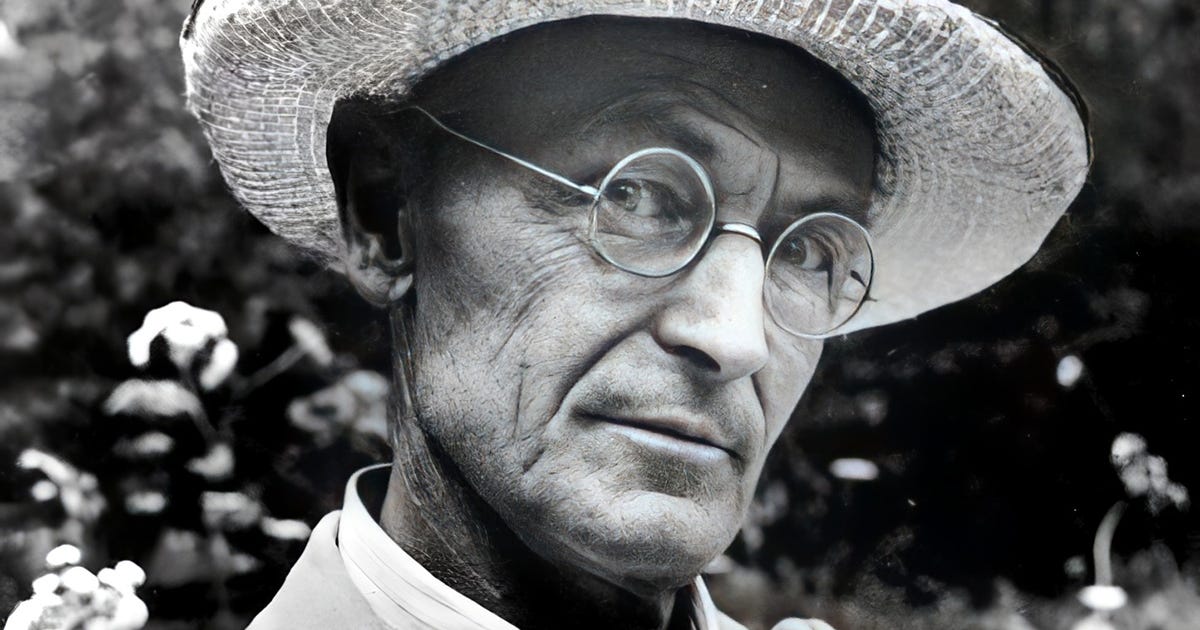
Hermann Hesse (1877-1962) was a German-Swiss poet, novelist, essayist, painter and mystic. His very interesting bio follows the translation.
"Stages" or "Steps"
by Hermann Hesse
from his novel The Glass Bead Game
loose translation/interpretation by Michael R. Burch
As every flower wilts and every youth
must wilt and exit life from a curtained stage,
so every virtue—even our truest truth—
blooms some brief time and cannot last forever.
Since life may summons death at any age
we must prepare for death’s obscene endeavor,
meet our end with courage and without remorse,
forego regret and hopes of some reprieve,
embrace death’s end, as life’s required divorce,
some new beginning, calling us to live.
Thus let us move, serene, beyond our fear,
and let no sentiments detain us here.
The Universal Spirit would not chain us,
but elevates us slowly, stage by stage.
If we demand a halt, our fears restrain us,
caught in the webs of creaturely defense.
We must prepare for imminent departure
or else be bound by foolish “permanence.”
Death’s hour may be our swift deliverance,
from which we speed to fresher, newer spaces,
and Life may summons us to bolder races.
So be it, heart! Farewell, and adieu, then!
The Poet
by Hermann Hesse
loose translation/interpretation by Michael R. Burch
Only upon me, the lonely one,
Do this endless night’s stars shine
As the fountain gurgles its faery song.
For me alone, the lonely one,
The shadows of vagabond clouds
Float like dreams over slumbering farms.
What is mine lies beyond possession:
Neither manor, nor pasture,
Neither forest, nor hunting permit …
What is mine belongs to no one:
The plunging brook beyond the veiling woods,
The terrifying sea,
The chick-like chatter of children at play,
The weeping and singing of a lonely man longing for love.
The temples of the gods are mine, also,
And the distant past’s aristocratic castles.
And mine, no less, the luminous vault of heaven,
My future home …
Often in flights of longing my soul soars heavenward,
Hoping to gaze on the halls of the blessed,
Where Love, overcoming the Law, unconditional Love for All,
Leaves them all nobly transformed:
Farmers, kings, tradesman, bustling sailors,
Shepherds, gardeners, one and all,
As they gratefully celebrate their heavenly festivals.
Only the poet is unaccompanied:
The lonely one who continues alone,
The recounter of human longing,
The one who sees the pale image of a future,
The fulfillment of a world
That has no further need of him.
Many garlands
Wilt on his grave,
But no one cares or remembers him.
On a Journey to Rest
by Hermann Hesse
loose translation/interpretation by Michael R. Burch
Don't be downcast, the night is soon over;
then we can watch the pale moon hover
over the dawning land
as we rest, hand in hand,
laughing secretly to ourselves.
Don't be downcast, the time will soon come
when we, too, can rest
(our small crosses will stand, blessed,
on the edge of the road together;
the rain, then the snow will fall,
and the winds come and go)
heedless of the weather.
Lonesome Night
by Hermann Hesse
loose translation/interpretation by Michael R. Burch
Dear brothers, who are mine,
All people, near and far,
Wishing on every star,
Imploring relief from pain;
My brothers, stumbling, dumb,
Each night, as pale stars ache,
Lift thin, limp hands for crumbs,
mutter and suffer, awake;
Poor brothers, commonplace,
Pale sailors, who must live
Without a bright guide above,
We share a common face.
Return my welcome.
How Heavy the Days
by Hermann Hesse
loose translation/interpretation by Michael R. Burch
How heavy the days.
Not a fire can warm me,
Nor a sun brighten me!
Everything barren,
Everything bare,
Everything utterly cold and merciless!
Now even the once-beloved stars
Look distantly down,
Since my heart learned
Love can die.
Without You
by Hermann Hesse
loose translation/interpretation by Michael R. Burch
My pillow regards me tonight
Comfortless as a gravestone;
I never thought it would be so bitter
To face the night alone,
Not to lie asleep entangled in your hair.
I lie alone in this silent house,
The hanging lamp softly dimmed,
Then gently extend my hands
To welcome yours …
Softly press my warm mouth
To yours …
Only to kiss myself,
Then suddenly I'm awake
And the night grows colder still.
The star in the window winks knowingly.
Where is your blonde hair,
Your succulent mouth?
Now I drink pain in every former delight,
Find poison in every wine;
I never knew it would be so bitter
To face the night alone,
Alone, without you.
Secretly We Thirst…
by Hermann Hesse
from his novel The Glass Bead Game
loose translation/interpretation by Michael R. Burch
Charismatic, spiritual, with the gracefulness of arabesques,
our lives resemble fairies’ pirouettes,
spinning gently through the nothingness
to which we sacrifice our beings and the present.
Whirling dreams of quintessence and loveliness,
like breathing in perfect harmony,
while beneath your bright surface
blackness broods, longing for blood and barbarity.
Spinning aimlessly in emptiness,
dancing (as if without distress), always ready to play,
yet, secretly, we thirst for reality
for the conceiving, for the birth pangs, for suffering and death.
Doch heimlich dürsten wir…
Anmutig, geistig, arabeskenzart
Scheint unser Leben sich wie das von Feen
In sanften Tänzen um das Nichts zu drehen,
Dem wir geopfert Sein und Gegenwart.
Schönheit der Träume, holde Spielerei,
So hingehaucht, so reinlich abgestimmt,
Tief unter deiner heiteren Fläche glimmt
Sehnsucht nach Nacht, nach Blut, nach Barbarei.
Im Leeren dreht sich, ohne Zwang und Not,
Frei unser Leben, stets zum Spiel bereit,
Doch heimlich dürsten wir nach Wirklichkeit,
Nach Zeugung und Geburt, nach Leid und Tod.
Across The Fields
by Hermann Hesse
loose translation/interpretation by Michael R. Burch
Across the sky, the clouds sweep,
Across the fields, the wind blunders,
Across the fields, the lost child
Of my mother wanders.
Across the street, the leaves sweep,
Across the trees, the starlings cry;
Across the distant mountains,
My home must lie.
EXCERPTS FROM "THE SON OF THE BRAHMAN"
by Hermann Hesse
loose translation/interpretation by Michael R. Burch
In the house-shade,
by the sunlit riverbank beyond the bobbing boats,
in the Salwood forest’s deep shade,
and beneath the shade of the fig tree,
that’s where Siddhartha grew up.
Siddhartha, the handsomest son of the Brahman,
like a young falcon,
together with his friend Govinda, also the son of a Brahman,
like another young falcon.
Siddhartha!
The sun tanned his shoulders lightly by the riverbanks when he bathed,
as he performed the sacred ablutions,
the sacred offerings.
Shade poured into his black eyes
whenever he played in the mango grove,
whenever his mother sang to him,
whenever the sacred offerings were made,
whenever his father, the esteemed scholar, instructed him,
whenever the wise men advised him.
For a long time, Siddhartha had joined in the wise men’s palaver,
and had also practiced debate
and the arts of reflection and meditation
with his friend Govinda.
Siddhartha already knew how to speak the Om silently, the word of words,
to speak it silently within himself while inhaling,
to speak it silently without himself while exhaling,
always with his soul’s entire concentration,
his forehead haloed by the glow of his lucid spirit.
He already knew how to feel Atman in his being’s depths,
an indestructible unity with the universe.
Joy leapt in his father’s heart for his son,
so quick to learn, so eager for knowledge.
Siddhartha!
He saw Siddhartha growing up to become a great man:
a wise man and a priest,
a prince among the Brahmans.
Bliss leapt in his mother’s breast when she saw her son's regal carriage,
when she saw him sit down,
when she saw him rise.
Siddhartha!
So strong, so handsome,
so stately on those long, elegant legs,
and when bowing to his mother with perfect respect.
Siddhartha!
Love nestled and fluttered in the hearts of the Brahmans’ daughters when Siddhartha passed by with his luminous forehead, with the aspect of a king, with his lean hips.
But more than all the others Siddhartha was loved by Govinda, his friend, also the son of a Brahman.
Govinda loved Siddhartha’s alert eyes and kind voice,
loved his perfect carriage and the perfection of his movements,
indeed, loved everything Siddhartha said and did,
but what Govinda loved most was Siddhartha’s spirit:
his transcendent yet passionate thoughts,
his ardent will, his high calling. …
Govinda wanted to follow Siddhartha:
Siddhartha the beloved!
Siddhartha the splendid!
…
Thus Siddhartha was loved by all, a joy to all, a delight to all.
But alas, Siddhartha did not delight himself. … His heart lacked joy. …
For Siddhartha had begun to nurse discontent deep within himself.
HERMANN HESSE BIO
Hermann Karl Hesse (1877-1962) was a German-Swiss poet, novelist, essayist, painter and mystic. and painter.
Hesse was born in Swabia, in Germany’s Black Forest region, to a Baltic German father and Swabian-Swiss mother. His grandmother had French-Swiss ancestry and his grandfather, Hermann Gundert, was a polyglot who compiled a Malayalam grammar, a Malayalam-English dictionary, and also contributed to a translation of the Bible into Malayalam. As a boy Hesse lived in the Swiss city of Basle from 1880 to 1886.
When he was just four years old, Hesse’s mother Marie wrote about his “unbelievable strength,” his “powerful will,” his “astonishing mind” and his “passionate turbulence.”
As a young man Hesse studied briefly at a seminary, struggled with depression, and at one point attempted suicide, which landed him temporarily in a sanatorium.
Hesse’s best-known works include Steppenwolf, Siddhartha, Demian, Narcissus and Goldmund and The Glass Bead Game. One of Germany’s greatest writers, Hesse was awarded the Nobel Prize in Literature in 1946.
In 1923, Hesse “resigned German” and acquired Swiss citizenship.
Why?
Hesse explains in his own words: “Soon after I settled in Switzerland in 1912, the First World War broke out, and each year brought me more and more into conflict with German nationalism; ever since my first shy protests against mass suggestion and violence I have been exposed to continuous attacks and floods of abusive letters from Germany. The hatred of the official Germany, culminating under Hitler, was compensated for by the following I won among the young generation that thought in international and pacifist terms, by the friendship of Romain Rolland, which lasted until his death, as well as by the sympathy of men who thought like me even in countries as remote as India and Japan. In Germany I have been acknowledged again since the fall of Hitler, but my works, partly suppressed by the Nazis and partly destroyed by the war; have not yet been republished there.
Translation Pages by Language:
English Translations of German Poets by Michael R. Burch
Germane Germans: English Translations by Michael R. Burch
English Translations of Anglo-Saxon Poems by Michael R. Burch
English Translations of French Poets by Michael R. Burch
English Translations of Chinese Poets by Michael R. Burch
English Translations of Female Chinese Poets by Michael R. Burch
English Translations of Japanese Poets by Michael R. Burch
English Translations of Japanese Zen Death Poems
English Translations of Ancient Mayan Love Poems
English Translations of Native American Poems, Proverbs and Blessings
English Translations of Roman, Latin and Italian Poets by Michael R. Burch
English Translations of Tamil Poets
English Translations of Urdu Poets by Michael R. Burch
English Translations of Uyghur Poets by Michael R. Burch
Thanks for posting this, Michael. I came across Herman Hesse while hitch hiking around Western Europe, aged 18. I met someone who was reading "Journey To The East," and I tracked down a copy myself - then went on to read most of his novels.
"The Glass Bead Game" was certainly the hardest to get through, but it rewarded persistence.
Best Wishes - Dave :)
I love Herman Hesse and have read many of his books over the decades, some twice! He just speaks to me so eloquently! Thanks Michael, G