
Playmates
"Playmates" is the second poem that I remember writing, at the tender age of 14, and a comment made by my English teacher was like rocket fuel to my aspiration to be a "real poet."

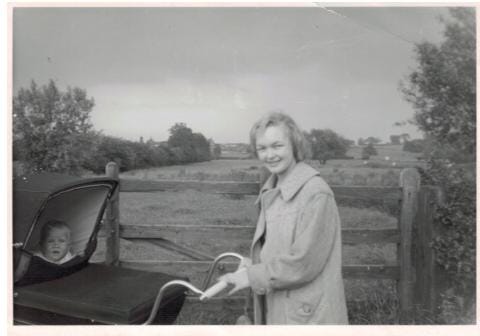
Playmates, circa age 14
by Michael R. Burch
WHEN you were my playmate and I was yours,
we spent endless hours with simple toys,
and the sorrows and cares of our indentured days
were uncomprehended ... far, far away ...
for the temptations and trials we had yet to face
were lost in the shadows of an unventured maze.
Then simple pleasures were easy to find
and if they cost us a little, we didn’t mind;
for even a penny in a pocket back then
was one penny too many, a penny to spend.
Then feelings were feelings and love was just love,
not a strange, complex mystery to be understood;
while “sin” and “damnation” meant little to us,
since forbidden cookies were our only lusts!
Then we never worried about what we had,
and we were both sure—what was good, what was bad.
And we sometimes quarreled, but we didn’t hate;
we seldom gave thought to the uncertainties of fate.
Hell, we seldom thought about the next day,
when tomorrow seemed hidden—adventures away.
Though sometimes we dreamed of adventures past,
and wondered, at times, why things couldn’t last.
Still, we never worried about getting by,
and we didn’t know that we were to die ...
when we spent endless hours with simple toys,
and I was your playmate, and we were boys.
This is probably the poem that “made” me, because my high school English teacher, Anne Meyers, called it “beautiful” and I took that to mean I was surely the Second Coming of Percy Bysshe Shelley!
“Playmates” was originally published by The Lyric.
This was the first poem that I remember writing…
Bible Libel, circa age 11-13
by Michael R. Burch
If God
is good
half the Bible
is libel.
I wrote “Bible Libel” after reading the bible from cover to cover at age 11. Yes, I was a heretic at that tender age, the black sheep and doubting Thomas in a family of devout evangelical Christians that included missionaries, pastors, Sunday school teachers (including my mother) and a deacon.
This was my first longish poem…
Happiness, circa age 13
Happiness is like a bubble,
What’s fine now will soon be trouble...
“Happiness” was my first attempt at a longish poem. It’s not a very good poem, but I think I did show a good ear for meter from the very beginning.
I was born in Orlando, Florida in 1958, then spent five of my first six years living in England — first with my English mother and her parents while my father was stationed at a US Air Force base in Thule, Greenland — then with both parents after dad returned to the land of the living and we were stationed in Gainsborough. Our family was far from rich, especially after the arrival of my pesky sisters Sandy and Debby, so we lived in a Gainsborough trailer park.
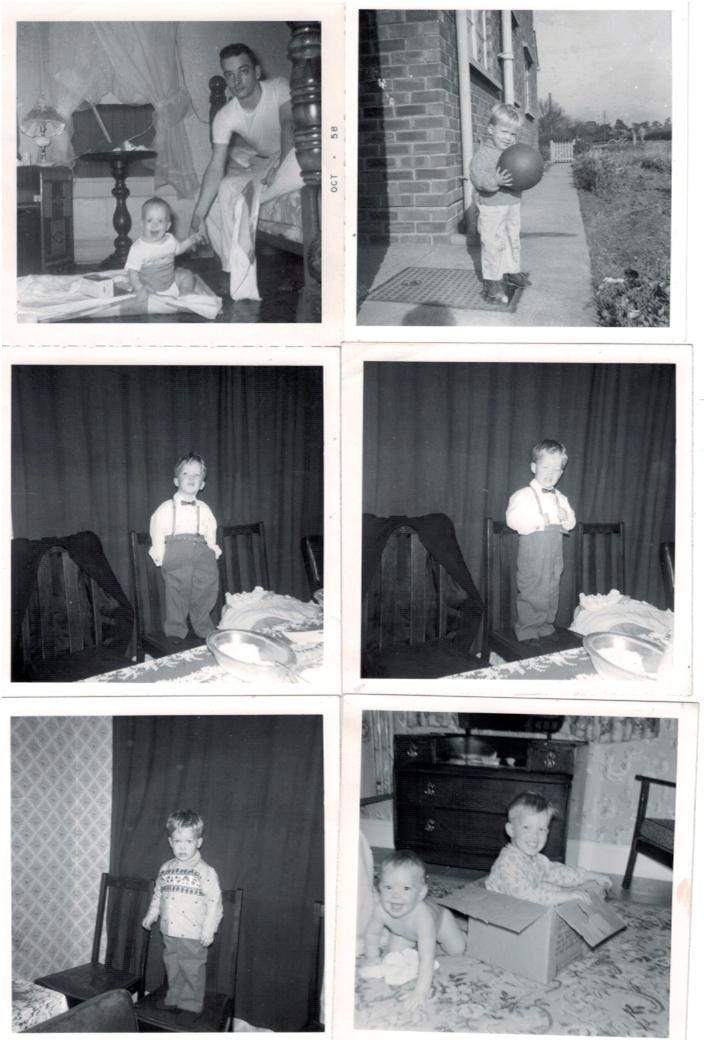
The first picture above is me with my father, Paul Ray Burch Jr., then me playing ball outside my grandparents’ house in Mattersey, England, followed by four pictures “I know not where, but wasn’t I a handsome little devil!”
One thing I remember vividly about England is picking blueberries and gooseberries while trying to avoid the omnipresent thorns, brambles and stinging nettles. England is mostly free of dangerous animals, but one must always beware of the overprotective vegetation!
alien
by michael r. burch, circa age 19
there are mornings in england
when, riddled with light,
the Blueberries gleam at us—
plump, sweet and fragrant.
but i am so small ...
what do i know
of the ways of the Daffodils?
“beware of the Nettles!”
we go laughing and singing,
but somehow, i, ...
i know i am lost. i do not belong
to this Earth or its Songs.
and yet i am singing ...
the sun—so mild;
my cheeks are like roses;
my skin—so fair.
i spent a long time there
before i realized: They have no faces,
no bodies, no voices.
i was always alone.
and yet i keep singing:
the words will come
if only i hear.
Published by Setu (India)
After our deployment in England came to an end, we were stationed at air bases in Lincoln, Nebraska, then Nashville, Tennessee (where my father’s parents lived), then Roseville, California. By age ten I was weary little world traveler who longed for some stability in his life and his playmates.
But no such luck. When I was eleven, my father was stationed at the huge Air Force base in Wiesbaden, Germany. We were forced to live off-base for two years, in a tiny German village, Bischofsheim, where there were no other American boys to play with, and no English language radio or TV stations. To avoid complete boredom, I began going to the base library, checking out eight books at a time (the limit), reading them in a few days, then continually repeating the process. I quickly exhausted the children’s books and began devouring adult fiction and nonfiction.
In the fifth grade, I tested at the reading level of a college sophomore and was placed in a reading group of one. I was a very fast reader with very good comprehension, a sort of Mozart of reading. I flew through books like crazy. I was reading Austen, Dickens, Hardy, Homer, Shakespeare, Twain, et al, while my classmates were reading whatever one normally reads in fifth grade. My grades shot through the roof and from that day forward I was always the top scholar in my classes, wherever I went.
But being bright and well-read does not invariably lead to happiness. I was tall, scrawny, introverted and socially awkward. I had trouble making friends. I began to dabble in poetry around age thirteen, but then the Burches were finally granted base housing and for two glorious years I was able to focus on things like marbles, quarters, comic books, baseball, basketball and football. And, from an incomprehensible distance, girls.
Smoke, circa age 14-15
by Michael R. Burch
The hazy, smoke-filled skies of summer I remember well;
farewell was on my mind, and the thoughts that I can't tell
rang bells within (the din was in) my mind, and I can't say
if what we had was good or bad, or where it is today.
The endless days of summer's haze I still recall today;
she spoke and smoky skies stood still as summer slipped away ..."Smoke" appeared in my high school journal, the Lantern, in 1976, and my college literary journal, Homespun, in 1977. It has since been published by The Eclectic Muse (Canada), Fullosia Press and Better Than Starbucks, and translated into Romanian and published by Petru Dimofte in Poezii. I had The Summer of '42 in mind when I wrote the poem. Ironically, I didn't see the movie until many years later (too young for an R-rated movie), but something about its advertisement touched me. The movie came out in 1971, so I was probably around 14 when I wrote “Smoke.”
We returned to the United States after I finished eighth grade at age 14. We didn’t have TV in Germany, so I must have seen The Summer of '42 trailer in Goldsboro, North Carolina, where I attended Faith Christian Academy because I wanted to play on the basketball team, or soon thereafter when we moved to Nashville after I finished the ninth grade (and hadn’t made any great inroads on my plan to be a professional basketball player at a scrawny 6’2” and 155 pounds).
I didn’t write much poetry from age 13 to 14, and when I did I wasn’t usually happy with the results.
Gone, circa age 14
by Michael R. Burch
Tonight, it is dark
and the stars do not shine.
A man who is gone
was a good friend of mine.
We were friends.
And the sky was the strangest shade of orange on gold
when I awoke to find him gone ...
"Gone" is actually gone, destroyed in a moment of frustration along with other poems I have not been able to recreate from memory. At some point, probably in late 1972 or early 1973, I destroyed all the poems I had written, out of frustration. I was able to recreate some of the poems from memory, but not all. "Gone" is the poem that haunts me the most. I have resurrected a few lines, but the rest appear to be gone completely. Another poem I regret destroying was titled "The Seven Stairs" and was inspired by one of my favorite rock songs, "Stairway to Heaven."
I am proud — inordinately proud, perhaps — that poems I wrote in my early teens have been published by literary journals that care about quality writing.
When I was fifteen my father retired from the Air Force and we moved back to his hometown of Nashville. While my parents were looking for a house, we lived with my grandfather, Paul Ray Burch Sr., and his third wife, Ruth. They didn’t have air-conditioning and didn’t seem to believe in hot food—even the peas and beans were served cold!—so I was sweaty, hungry, lonely, friendless and miserable. It was at this point that I began to write poetry seriously. I’m not sure why. Perhaps because my options seemed so limited and the world so impossibly bleak, grim and unfair.
Have I been too long at the fair?, circa age 15
by Michael R. Burch
Have I been too long at the fair?
The summer has faded,
the leaves have turned brown;
the Ferris wheel teeters ...
not up, yet not down.
Have I been too long at the fair?
This is one of my very earliest poems, written around age 15 when we were living with my grandfather in his house on Chilton Street, within walking distance of the Nashville fairgrounds. That was before my sophomore year of high school. I remember walking to the fairgrounds, stopping at a Dairy Queen along the way, and swimming at a public pool. I believe the Ferris wheel only operated during the state fair, so my “educated guess” is that this poem was written during the 1973 state fair, or shortly thereafter. I remember watching people hanging suspended in mid-air, waiting for carnies to deposit them safely on terra firma again. In any case, this poem was published in my high school literary journal, the Lantern.
Writing poetry helped me cope with my loneliness, boredom and depression. I had feelings of deep alienation and inadequacy, but suddenly I had found something I could do better than anyone around me. (Perhaps because no one else was doing it at all?)
However, I was a perfectionist and poetry can be very tough on perfectionists. I remember becoming incredibly frustrated and angry with myself. Why wasn’t I writing poetry like Shelley and Keats at age fifteen? I destroyed all my poems in a fit of pique. Fortunately, I was able to reproduce most of the better poems from memory, but two in particular were lost forever and still haunt me.
Leave Taking, circa age 14-15
by Michael R. Burch
Brilliant leaves abandon battered limbs
to waltz upon ecstatic winds
until they die.
But the barren and embittered trees,
lament the frolic of the leaves
and curse the bleak November sky ...
Now, as I watch the leaves' high flight
before the fading autumn light,
I think that, perhaps, at last I may
have learned what it means to say—
goodbye.
Several of my early poems were about aging, loss and death. Young poets can be so morbid! As with "Death/Styx" this poem is the parings of a longer poem. Most of my poems end up being sonnet-length or shorter. I think the sounds here are pretty good for a young poet "testing his wings." This poem started out as a stanza in a much longer poem, "Jessamyn's Song," that dates to around age 14-16. "Leave Taking" has been published by The Lyric, Mindful of Poetry, Silver Stork Magazine and There is Something in the Autumn (an anthology).
Up to age fifteen, I had never shown my poems to anyone, not even my beloved mother or my pesky sisters.
Am I, circa age 14-15
by Michael R. Burch
Am I inconsequential;
do I matter not at all?
Am I just a snowflake,
to sparkle, then to fall?
Am I only chaff?
Of what use am I?
Am I just a flame,
to flicker, then to die?
Am I inadvertent?
For what reason am I here?
Am I just a ripple
in a pool that once was clear?
Am I insignificant?
Will time pass me by?
Am I just a flower,
to live one day, then die?
Am I unimportant?
Do I matter either way?
Or am I just an echo—
soon to fade away?
This seems like a pretty well-crafted poem for a teenage poet just getting started. Since I was a little heretic with intimate knowledge of the Bible, the title is a reversal of the biblical "I Am."
I believe I wrote the following poem, a bookend of sorts, on the same day that I wrote “Am I?” or very soon thereafter…
Time, circa age 14-15
by Michael R. Burch
Time,
where have you gone?
What turned out so short,
had seemed like so long.
Time,
where have you flown?
What seemed like mere days
were years come and gone.
Time,
see what you've done:
for now I am old,
when once I was young.
Time,
do you even know why
your days, minutes, seconds
preternaturally fly?
”Time” appeared in my high school project notebook "Poems" along with "Playmates." This seems like a pretty well-crafted poem for a teenage poet.
In the tenth grade, at age sixteen, I had a major breakthrough. My English teacher Anne Meyers gave us a poetry assignment. We were instructed to create a poetry booklet with five themes of our choosing. I still have my booklet, a treasured memento, banged out on a Corona typewriter with cursive script, which gave it a sort of elegance, a cachet. My chosen chapters were: Rock Songs, English Poems, Animal Poems, Biblical Poems, and ta-da, My Poems! Audaciously, alongside the poems of Shakespeare, Burns and Tennyson, I would self-publish my fledgling work!
Ms. Meyers wrote “This poem is beautiful” beside my poem “Playmates.” Her comment was like rocket fuel to my stellar aspirations. Surely I was the next Keats, the next Shelley! Surely success was now fait accompli, guaranteed!
Of course I had no idea what I was getting into. How many teenage poets can compete with the immortal bards? I was in for some tough sledding because I had good taste in poetry and could tell the difference between merely adequate verse and the real thing. I continued to find poetry vexing. Why the hell wouldn’t it cooperate and anoint me its next Shakespeare, pronto?
Then I had another breakthrough. I remember it vividly. I working at a McDonald’s at age seventeen, salting away money for college because my parents had informed me they couldn’t afford my tuition. Fortunately, I was able to earn a full academic scholarship, but I still needed to make money for clothes, dating (ha!), etc. I was sitting in the McDonald’s break room when I wrote a poem, “Reckoning” (later re-titled “Observance”), that made me catch my breath. Did I write that? For the first time, I felt like a “real poet.”
Observance
by Michael R. BurchHere the hills are old, and rolling
casually in their old age;
on the horizon youthful mountains
bathe themselves in windblown fountains . . .By dying leaves and falling raindrops,
I have traced time's starts and stops,
and I have known the years to pass
almost unnoticed, whispering through treetops . . .For here the valleys fill with sunlight
to the brim, then empty again,
and it seems that only I notice
how the years flood out, and in . . .
For me, “Observance” was like Balboa hacking his way through jungles and climbing mountains, to finally sight the Pacific Ocean. A moment of revelation and wonder.
I wanted to be a real poet, but that was much easier said than done.
Around age 14 or early my 15th year, I destroyed all my poems because I wasn’t rivaling Shelley and Keats.
I felt like a failure.
But then “Observance” came to me, and it gave me hope, like sighting the fabled Pacific.
Another poem, “Infinity,” written around age eighteen, again made me feel like a real poet.
Infinity
by Michael R. BurchHave you tasted the bitterness of tears of despair?
Have you watched the sun sink through such pale, balmless air
that your soul sought its shell like a crab on a beach,
then scuttled inside to be safe, out of reach?Might I lift you tonight from earth’s wreckage and damage
on these waves gently rising to pay the moon homage?
Or better, perhaps, let me say that I, too,
have dreamed of infinity . . . windswept and blue.
Now, two “real poems” in two years may not seem like a big deal to non-poets. But they were very big deals to me. I would head off to college feeling that I was a real poet, with two real poems under my belt. I felt like someone, at last. I had, at least, potential.
But I was in for another rude shock. Being a good reader of poetry—good enough to know when my poems were falling short of the mark—I was absolutely floored when I learned that impostors were controlling Poetry’s fate! These impostors were claiming that meter and rhyme were passe, that honest human sentiment was something to be avoided, that poetry should be based always and only on concrete imagery, etc.
At first I was devastated, but then I quickly became enraged. I knew the difference between good poetry and bad. I could feel it in my flesh, in my bones. Who were these impostors to say that bad poetry was good, and good was bad? How dare they? I was incensed! I loved Poetry. I saw her as my Savior because she had rescued me from depression and feelings of inadequacy. So I made a poetic pledge to aid my Savior in her battles with the impostors…
Poetry, circa age 18-19
by Michael R. BurchPoetry, I found you where at last they chained and bound you;
with devices all around you to torture and confound you,
I found you—shivering, bare.They had shorn your raven hair and taken both your eyes
which, once cerulean as Gogh’s skies, had leapt with dawn to wild surmise
of what was waiting there.Your back was bent with untold care; there savage brands had left cruel scars
as though the wounds of countless wars; your bones were broken with the force
with which they’d lashed your flesh so fair.You once were loveliest of all. So many nights you held in thrall
a scrawny lad who heard your call from where dawn’s milling showers fall—
pale meteors through sapphire air.I learned the eagerness of youth to temper for a lover’s touch;
I felt you, tremulant, reprove each time I fumbled over-much.
Your merest word became my prayer.You took me gently by the hand and led my steps from boy to man;
now I look back, remember when—you shone, and cannot understand
why here, tonight, you bear their brand.I will take and cradle you in my arms, remindful of the gentle charms
you showed me once, of yore;
and I will lead you from your cell tonight—back into that incandescent light
which flows out of the core of a sun whose robes you wore.
And I will wash your feet with tears for all those blissful years . . .
my love, whom I adore.Originally published by The Lyric
I consider "Poetry" to be my Ars Poetica. However, the poem has been misinterpreted as the poet claiming to be Poetry's "savior." The poet never claims to be a savior or hero. The poem only says that when Poetry is finally freed, in some unspecified way, the poet will be there to take her hand and watch her glory be re-revealed to the world. The poet expresses love for Poetry, and gratitude, but never claims to have done anything himself. This is a poem of love, compassion and reverence. Poetry is the Messiah, not the poet. The poet washes her feet with his tears, like Mary Magdalene.
Keywords/Tags: Poetry, Ars Poetica, Messiah, disciple
This is Word-Bird of the tiny team. Thank-coos for sharing these poems, Mike! It is always a pleasure to read your oeuvres. I shall be in touch soon with regard to our June issue (^v^)👍