
Stars
"Stars" is an early poem of mine that I had forgotten for nearly half a century until another poet, Janet Kenny, reminded me of its existence...

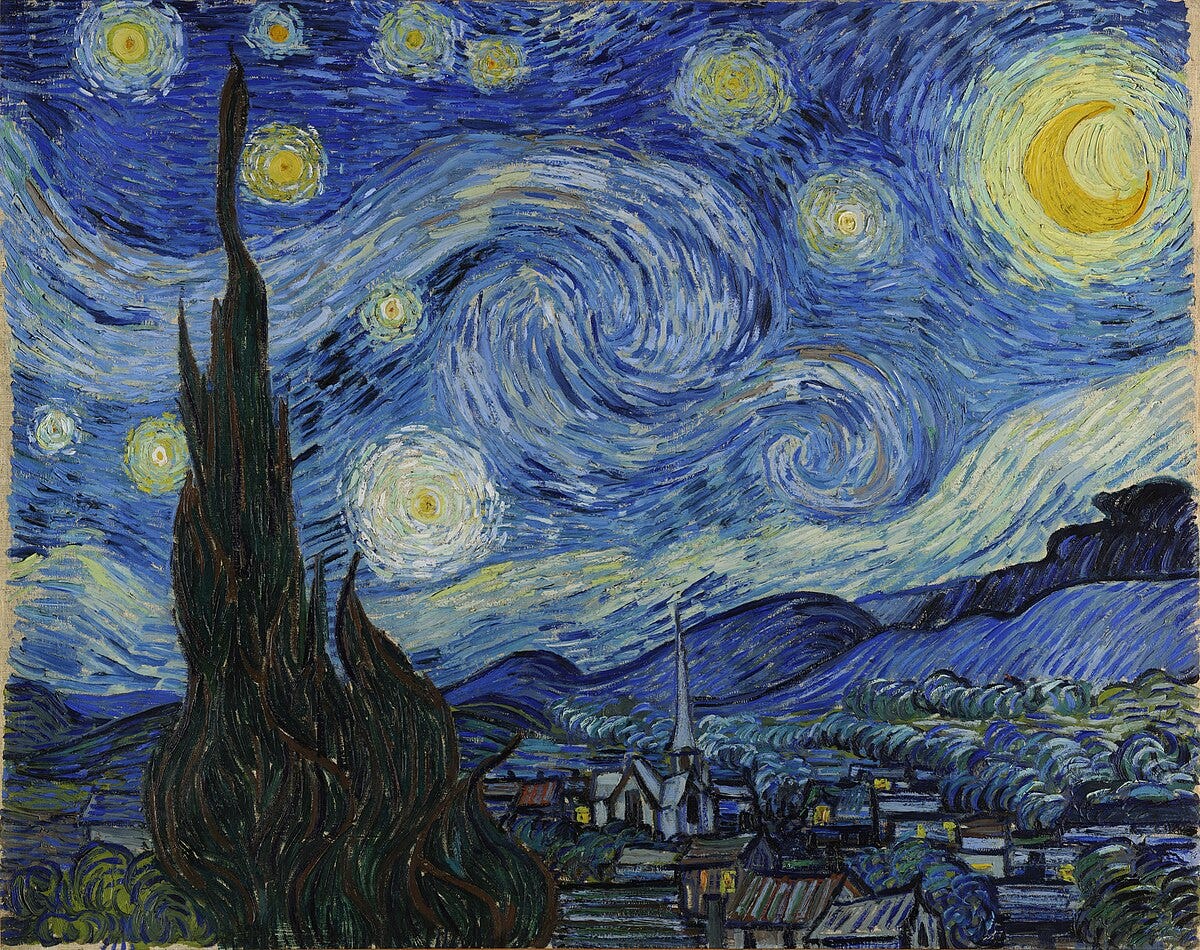
One of my favorite contemporary poets, Janet Kenny, submitted a poem titled “Stars” that I will be publishing in the near future via The HyperTexts. Janet’s title and the sadness of her poem reminded me of this early poem of mine, written in my early twenties…
Stars
by Michael R. Burch, age 22
Though night has come,
I'm not alone,
for stars appear
—fierce, faint and far—
to dance until they disappear.
They reappear
as clouds roll by
in stormy billows
past bent willows;
sometimes they almost seem to sigh.
And time rolls on,
on past the willows,
on past the stormclouds as they billow,
on to the stars
so faint and far . . .
on to the stars
so faint and far.
LANGUISHMENTS AND RECLAMATIONS
These are other early poems of mine that languished for decades until I finally got around to publishing them…
Because You Came to Me
by Michael R. Burch, circa age 18
for Beth
Because you came to me with sweet compassion
and kissed my furrowed brow and smoothed my hair,
I do not love you after any fashion,
but wildly, in despair.
Because you came to me in my black torment
and kissed me fiercely, blazing like the sun
upon parched desert dunes, till in dawn’s foment
they melt, I am undone.
Because I am undone, you have remade me
as suns bring life, as brilliant rains endow
the earth below with leaves, where you now shade me
and bower me, somehow.
I wrote the first version of this poem around age 18, then forgot about it for 30 years. Then something about my wife Beth made me remember the poem, so I revised it and dedicated it to her.
alien
by michael r. burch, circa age 19-20
there are mornings in england
when, riddled with light,
the Blueberries gleam at us—
plump, sweet and fragrant.
but i am so small ...
what do i know
of the ways of the Daffodils?
“beware of the Nettles!”
we go laughing and singing,
but somehow, i, ...
i know i am lost. i do not belong
to this Earth or its Songs.
and yet i am singing ...
the sun—so mild;
my cheeks are like roses;
my skin—so fair.
i spent a long time there
before i realized: They have no faces,
no bodies, no voices.
i was always alone.
and yet i keep singing:
the words will come
if only i hear.
Published by Setu (India)
One of my earliest memories is picking blueberries amid the brambles surrounding the tiny English hamlet, Mattersey, where I and my mother lived with her parents while my American father was stationed in Thule, Greenland, where dependents were not allowed. Was that because of the weather or the nukes? In any case, England is free of dangerous animals, but one must be wary of the copious thorns and nettles. I seem to remember writing this poem as a college sophomore, around age 19, in 1977. According to my notes, I revised the poem many years later, in March 2001.
Sharon
by Michael R. Burch, circa age 15-17
apologies to Byron
I.
Flamingo-minted, pink, pink cheeks,
dark hair streaked with a lisp of dawnlight;
I have seen your shadow creep
through eerie webs spun out of twilight…
And I have longed to kiss your lips,
as sweet as the honeysuckle blooms;
to hold your pale albescent body,
more curvaceous than the moon…
II.
Black-haired beauty, like the night,
stay with me till morning's light.
In shadows, Sharon, become love
until the sun lights our alcove.
Red, red lips reveal white stone:
whet my own, my passions hone.
My all in all I give to you,
in our tongues' exchange of dew.
Now all I ever ask of you
is: do with me what now you do.
In shadows, Sharon, shed your gown;
let all night's walls come tumbling down.
III.
Now I will love you long, Sharon,
as long as longing may be.
The first and third sections are all I can remember of a "Sharon" poem that I destroyed in a fit of frustration about my writing, around age 15. The middle section was a separate poem written around age 17. My "Sharon" poems were influenced by Lord Byron's famous poem "She Walks in Beauty (Like the Night)."
All My Children
by Michael R. Burch, circa age 14-15
It is May now, gentle May,
and the sun shines pleasantly
upon the blousy flowers
of this backyard cemet'ry,
upon my children as they sleep.
Oh, there is Hank in the daisies now,
with a mound of earth for a pillow;
his face as harsh as his monument,
but his voice as soft as the wind through the willows.
And there is Meg beside the spring
that sings her endless sleep.
Though it’s often said of stiller waters,
sometimes quicksilver streams run deep.
And there is Frankie, little Frankie,
tucked in safe at last,
a child who weakened and died too soon,
but whose heart was always steadfast.
And there is Mary by the bushes
where she hid so well,
her face as dark as their berries,
yet her eyes far darker still.
And Andy ... there is Andy,
sleeping in the clover,
a child who never saw the sun
so soon his life was over.
And Em'ly, oh my Em'ly!,
the prettiest of all ...
now she's put aside her dreams
of beaus kind, dark and tall
for dreams dreamed not at all.
It is May now, gentle May
and the sun shines pleasantly
upon this backyard garden,
on the graves of all my children ...
God, keep them safe until
I join them, as I will.
God, guard their tender dust
until I meet them, as I must.
"All My Children" is a poem I had forgotten for nearly 50 years until another poet, Robert Lavett Smith, mentioned the poem "We Are Seven" by William Wordsworth. As I read Wordsworth's poem about a little girl who refused to admit that some of her siblings were missing, I remembered a poem I had written as a teenager about a mother who clung as tenaciously to the memory of her children. The line "It is May now, merry May" popped into my head and helped me locate the poem in my archives. I believe I wrote this poem about the same time as "Jessamyn's Song," which would place it around 1972-1974 at age 14-16, or thereabouts. I can tell it's one of my early poems because I was still allowing myself archaisms like "cemet'ry" which I would have avoided in my late teens and twenties. It feels a bit older than "Jessamyn's Song" so I will guess 1972, around age 14. It is admittedly a sentimental poem, but then human beings are sentimental creatures. I believe the poem was influenced by Little Women, the first book that made me cry.
Accounting
by Michael R. Burch, circa age 20
And so I have loved you, and so I have lost,
accrued disappointment, ledgered its cost,
debited wisdom, accredited pain ...
My assets remaining are liquid again.
I think I wrote this poem around the time my sister Debby decided to major in accounting. I had taken an accounting class either my freshman or sophomore year, so I was familiar with debits and credits. A guess for the composition date might be 1978-1980.
Shakespeare's Sonnet 130 Refuted, circa age 18
by Michael R. Burch
My mistress' eyes are nothing like the sun;
Coral is far more red than her lips' red;
— Shakespeare, Sonnet 130
Seas that sparkle in the sun
without its light would have no beauty;
but the light within your eyes
is theirs alone; it owes no duty.
Whose winsome flame, not half so bright,
is meant for me, and brings delight.
Coral formed beneath the sea,
though scarlet-tendriled, cannot warm me;
while your lips, not half so red,
just touching mine, at once inflame me.
Whose scorching flames mild lips arouse
fathomless oceans fail to douse.
Bright roses’ brief affairs, declared
when winter comes, will wither quickly.
Your cheeks, though paler when compared
with them?—more lasting, never prickly.
Whose tender cheeks, so enchantingly warm,
far vaster treasures, harbor no thorns.
Originally published by Romantics Quarterly
This was my first sonnet, written in my teens after I discovered Shakespeare's "Sonnet 130." At the time I didn't know the rules of the sonnet form, so mine is a bit unconventional. I think it is not bad for the first attempt of a teen poet. I remember writing this poem in my head on the way back to my dorm from a freshman English class. I would have been 18 or 19 at the time.
absinthe sea
by Michael R. Burch, circa agee 18-19
i hold in my hand a goblet of absinthe
the bitter green liqueur
reflects the dying sunset over the sea
and the darkling liquid froths
up over the rim of my cup
to splash into the free,
churning waters of the sea
i do not drink
i do not drink the liqueur,
for I sail on an absinthe sea
that stretches out unendingly
into the gathering night
its waters are no less green
and no less bitter,
nor does the sun strike them with a kinder light
they both harbor night,
and neither shall shelter me
neither shall shelter me
from the anger of the wind
or the cruelty of the sun
for I sail in the goblet of some Great God
who gazes out over a greater sea,
and when my life is done,
perhaps it will be because
He lifted His goblet and sipped my sea.
I seem to remember writing this poem in college, just because I liked the sound of the word “absinthe.” I had no idea, really, what it was or what absinthe looked or tasted like, beyond something I had read somewhere.
49th Street Serenade
by Michael R. Burch, circa age 16
It's four o'clock in the mornin'
and we're alone, all alone in the city . . .
your sneakers 're torn
and your jeans 're so short
that your ankles show, but you're pretty.
I wish I had five dollars;
I'd pay your bus fare home,
but how far canya go
through the sleet 'n' the snow
for a fistful of change?
'Bout the end of Childe’s Lane.
Right now my old man is sleepin'
and he don't know the hell where I am.
Why he still goes to bed
when he's already dead,
I don't understand,
but I don't give a damn.
Bein' sixteen sure is borin'
though I guess for a girl it's all right . . .
if you'd let your hair grow
and get some nice clothes,
I think you'd look outta sight.
And I wish I had ten dollars;
I'd ask you if you would . . .
but wishin's no good
and you'd think I'm a hood,
so I guess I'll be sayin' good night.
This is one of my earliest poems; I began writing songs when some long-haired friends of mine started a band around 1974. But I was too introverted and shy to show them to anyone. This one was too racy for my high school journal.
Having Touched You
by Michael R. Burch, circa age 17-18
What I have lost
is not less
than what I have gained.
And for each moment passed
like the sun to the west,
another remained,
suspended in memory
like a flower in crystal
so that eternity
is but an hour, and fall
is no longer a season
but a state of mind.
I have no reason
to wait; the wind
does not pause for remembrance
or regret
because there is only fate and chance.
And so then, forget ...
Forget we were utterly
happy a day.
That day was my lifetime.
Before that day I was empty
and the sky was grey.
You were the sunshine,
the sunshine that gave me life.
I took root and I grew.
Now the touch of death is like a terrible knife,
and yet I can bear it,
having touched you.
Odd, the things that inspire us! I wrote this poem after watching The Boy in the Bubble: a made-for-TV movie, circa 1976, starring John Travolta. So I would have been around 17 or 18 at the time. It may be an overtly sentimental poem, but I still like it. I don't think poets have to be too "formidable" to feel. But how many contemporary poets are foolhardy enough to admit writing sappy poems in response to other people's tear-jerkers? Once again, I may be unique!
A midnight shade of blue
by Michael R. Burch, circa age 16
You thought you saw a shadow moving somewhere in the night—
a lost and lonely stranger searching for a little light—
so you told me to approach him, ask him if he'd like a room . . .
how sweet of you to think of someone wandering in the gloom,
but he was only
a midnight shade of blue.
I thought I saw an answer shining somewhere in the night—
a spark of truth irradiating wisdom sweet and bright—
but when I sought to seize it, to bring it home to you . . .
it fluttered through my fingers like a wispy curlicue,
for it was only
a midnight shade of blue.
We thought that we had found true love together in the night—
a love as fine and elegant as wine by candlelight—
but when we woke this morning, we knew it wasn't true . . .
the "love" we'd shared was less than love; I guess we owe it to
emotion,
and a midnight shade of blue.
I seem to remember writing this one during my early songwriting phase. That would be around 1974, give or take. While I don’t claim it’s a great poem, I think I did show a pretty good touch with meter in my youth.
A pledge for ignorance
by Michael R. Burch, circa age 15
In these troubled times,
when truth and conjecture
are no longer distinguished
by the common man,
who accepts all things
as part of some ultimate plan,
believing, perhaps rightly so,
that any gods existing now
shall soon be overthrown,
I have closed my eyes and seen
the dissolution of my beliefs.
Once I thought myself secure
belonging to a race of logic and science,
infallible, perhaps capable
of conquering the universe…
but as I have seen the plight
of my people growing worse and worse,
today I attempt not to think at all,
nor do I scale the heights that I once did;
having experienced one harrowing fall,
I will not risk another
even to save a brother.
For thought is like the flight of birds
that rise to heights unknown to men,
till, grazing the orbits of fiery stars,
they fall to earth, their feathers singed.
So I will not venture those starry paths
by moons unseen and planets ringed,
but I will live my life below,
secure in blissful ignorance,
never approaching thought's orbs aglow…
and though I may be wrong in this,
what I have not seen, I have not missed.
In this poem, I unleashed my inner 15-year-old cynic and I don't think it can be taken seriously. This poem was published in my college literary journal, Homespun, in the 1977-1978 issue. It was the first poem in that issue.
Adagio
by Michael R. Burch, circa age 21
Speed, splendid light,
through webbed membranes of the mind
enmeshed in sleep.
Beat
and beat
and beat,
sweet soothing spray.
Dance within a dream of yester days.
Rush
and rush
and rush,
red rivers—on!
Flood yourselves and rage beyond the sun.
Dance
and dance
and dance,
electric thoughts.
Calculate life's worth, and all its costs.
Rage
and rage
and rage
strange passions where
the darkness rises, stifling the air.
Throb
and throb
and throb
O, ecstasies!
Burst in glorious grandeur through night’s dreams.
Rise
and rise
and rise
now Poetry.
Laugh and weep and curse life's fallacies.
And speed, splendid light
through webbed membranes of the mind
enmeshed in sleep.
I believe I wrote this poem in college, around 1979, which would have made me around 21 years old. This one is all about the music of words.
Alice
by Michael R. Burch, circa age 15
There were nights when we would wander together
the banks of a lake cast in strange monotones
where once I had wandered before,
lost and alone.
And along the moonlit banks we strolled
the silver waterfalls recoiled
to, screaming, die upon the folds
of tranquil waters far below.
For tranquil waters fed below
on melting ice and crumbling stone.
The nights we spent beside that lake
we spent there with the stately drake,
the graceful swan, the grotesque eel,
close to the sound of a waterfall's peal,
close to the sound of a lake's midnight meal.
And Alice's hair hung like hacked hemp,
gnarled and twisted on the wind,
glistening with an unearthly light,
Medusan at midnight.
And her lips shone with a radiance
that blinded my eyes
as they closed in reply
to the slightest pressure of her touch;
and I wanted her so much …
but did not have her,
for the lake that gave her soon took her away.
For she died in the mists of a moonlit night
with a rush of green water filling her mouth; …
then the skies
rang with her startled cries
and her algaed eyes
gleamed agony.
She pled with me …
"Come too, come too!" She softly begged.
"Oh, no! I can't!" I witlessly said.
And she, the enchantress, was sucked down;
some will say that she drowned …
But her eyes were the eyes of that eerie lake
and her lips mouthed its soft and eloquent plea
in a voice weirdly ancient, wild and free,
crying, "I am Alice … come to me!"
This is one of my earliest poems, written around age 15.
Again and Again and Again
by Michael R. Burch, circa age 20
Your voice is bluer than midnight’s bluest,
deepest, darkest shade of the sky,
so sing me a lullaby
as soft as the softest kitten’s sighs.
And your lips are warmer than August’s warmest,
calmest, clearest, sun-drenched day,
so kiss me with kisses that cannot help
but take my breath away.
Your hair is softer than autumn’s softest,
lightest, evenest evening rain,
so veil me with tresses, ah!, able
to ease my every pain.
Your smile is brighter than morning’s
brightest, barest carnation,
so smile for me; say that you love me
again and again and again.
Gainesboro(ugh)
by Michael R. Burch, circa age 15
Times forgotten, times reviled
were all you gave this child, beguiled,
besides one ghostly memory
to haunt him down Life’s winding wild.
And though his character was formed
somewhere within your lightless shade,
not a fragment of the man
that he became today remains
anywhere within the gloom
cast by your dark insidious trees ...
for fleeting dreams and memories
are only dreams and memories.
According to my memory and notes, I wrote the first version of this poem around 1973, circa age 15, revised it in 1978, then finally completed it a mere 48 years later at age 63! I actually have quite a few memories of Gainsborough and none are as dark as the poem might make it seem. The poem is really a complaint about life on earth resulting in divisions and losses. Gainsborough is mostly lost to me, and I am entirely lost to Gainsborough. We are divided by time and distance, and while I hazily remember Gainsborough, I’m sure Gainsborough remembers me not at all, since I was so small and insignificant when we knew each other. However, if a poet is read, he may be remembered...
Love your Leo poems.
A charming compilation. What a romantic you were! - and presumably still are.