
THE WANDERER
This is my modern English translation of the ancient Old English/Anglo-Saxon poem “The Wanderer.”

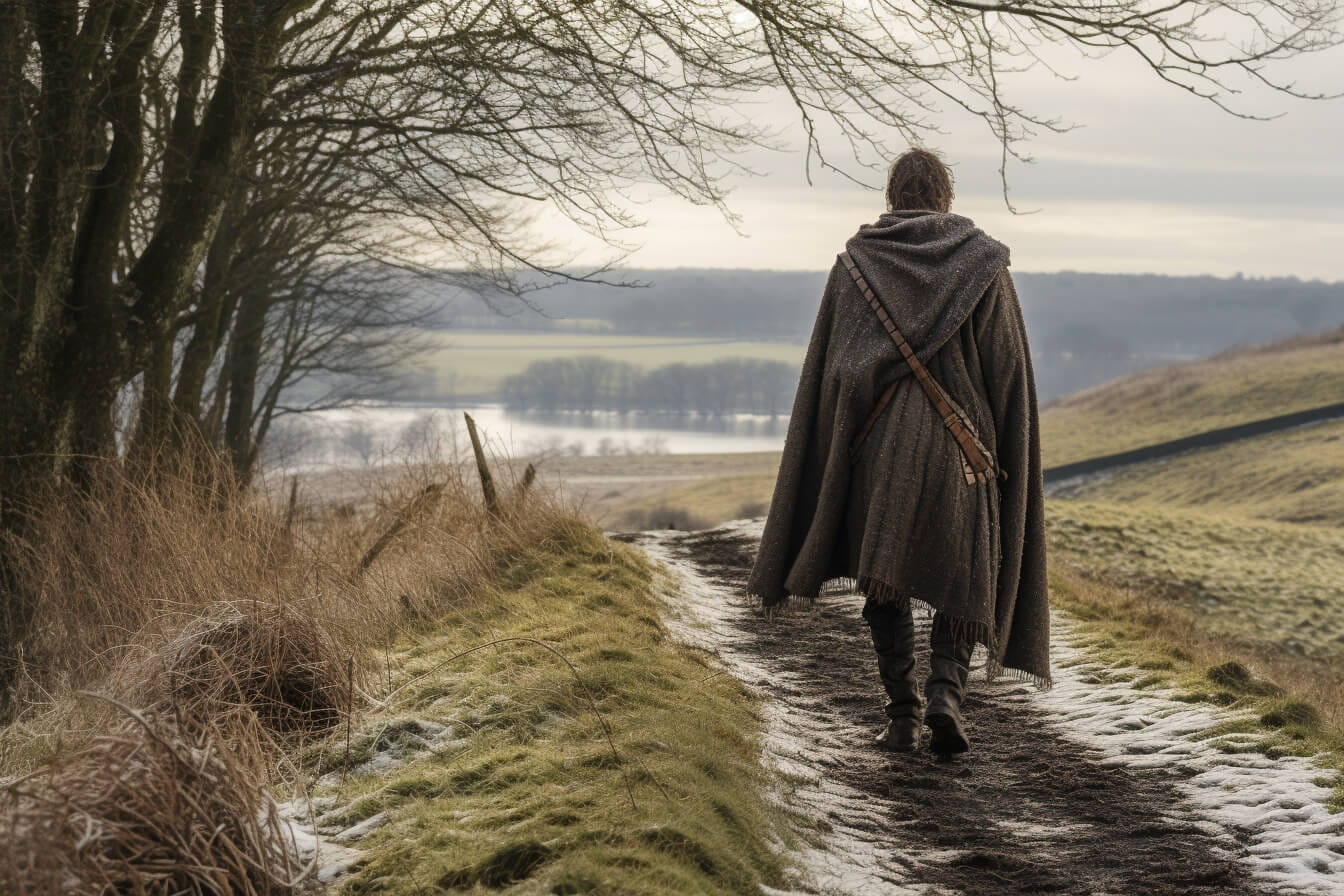
Please keep in mind that in ancient Anglo-Saxon poems like “The Ruin” and “The Wanderer” the Wyrdes function like the Fates of ancient Greek mythology, controlling men’s destinies.
The Wanderer
ancient Anglo-Saxon poem, circa 990 AD
loose translation/interpretation by Michael R. Burch
“The one who wanders alone
longs for mercy, longs for grace,
knowing he must yet traverse
the whale-path’s rime-cold waters,
stirring the waves with his hands & oars,
heartsick & troubled in spirit,
always bending his back to his exile-ways.”
“Fate is inexorable.”
Thus spoke the wanderer, the ancient earth-roamer
mindful of life’s hardships,
of its cruel slaughters & deaths of dear kinsmen.
“Often I am driven, departing alone at daybreak,
to give my griefs utterance,
the muffled songs of a sick heart
sung to no listeners, to no living lord,
for now there are none left alive
to debate my innermost doubts.
Custom considers it noble indeed for a man
to harbor his thought-hoard,
keep it close to his chest,
slam the doors of his doubts shut,
bind sorrow to silence & be still.
But the weary-minded man cannot withstand Wyrdes,
nor may his shipwrecked heart welcome solace, nor any hope of healing.
Therefore those eager for fame often bind dark thoughts
& unwailed woes in their breast-coffers.
Thus, miserably sad, overcome by cares & separated from my homeland,
far from my noble kinsmen, I was forced to bind my thoughts in iron fetters,
to confine my breast-hoard to its cage of bone.
Long ago the dark earth covered my gold-lord & I was left alone,
winter-weary & wretched, to cross these wrenching waves friendless.
Saddened, I sought the hall of some new gold-giver,
someone who might take heed of me, welcome me,
hoping to find some friendly mead-hall
offering comfort to men left friendless by Fate.
Anyone left lordless, kinless & friendless
knows how bitter-cruel life becomes
to one bereft of protectors,
pale sorrows his only companions.
No one waits to welcome the wanderer!
His only rewards, cold nights & the frigid sea.
Only exile-paths await him,
not torques of twisted gold,
warm hearths & his lord’s trust.
Only cold hearts’ frozen feelings, not earthly glory.
Then he longingly remembers retainers, feasts & the receiving of treasure,
how in his youth his gold-friend recognized him at the table.
But now all pleasure has vanished & his dreams taste like dust!
The wanderer knows what it means to do without:
without the wise counsels of his beloved lord, kinsmen & friends.
The lone outcast, wandering the headlands alone,
where solitariness & sorrow sleep together!
Then the wretched solitary vagabond
remembers in his heart how he embraced & kissed his lord
& laid his hands & head upon his knee,
in those former days of grace at the gift-stool.
But the wanderer always awakes without friends.
Awakening, the friendless man confronts the murky waves,
the seabirds bathing, broadening out their feathers,
the hoar-frost, harrowing hail & snow eternally falling…
Then his heart’s wounds seem all the heavier for the loss of his beloved lord.
Thus his sorrow is renewed,
remembrance of his lost kinsmen troubles his mind,
& he greets their ghosts with exclamations of joy, but they merely swim away.
The floating ones never tarry.
Thus care is renewed for the one whose weary spirit rides the waves.
Therefore I cannot think why, surveying this world,
my mind should not contemplate its darkness.
When I consider the lives of earls & their retainers,
how at a stroke they departed their halls, those mood-proud thanes!,
then I see how this middle-earth fails & falls, day after day…
Therefore no man becomes wise without his share of winters.
A wise man must be patient,
not hot-hearted, nor over-eager to speak,
nor weak-willed in battles & yet not reckless,
not unwitting nor wanting in forethought,
nor too greedy for gold & goods,
nor too fearful, nor too cheerful,
nor too hot, nor too mild,
nor too eager to boast before he’s thought things through.
A wise man forbears boastmaking
until, stout-hearted, his mind sure & his will strong,
he can read the road where his travels & travails take him.
The wise man grasps how ghastly life will be
when all the world’s wealth becomes waste,
even as middle-earth already is, in so many places
where walls stand weather-beaten by the wind,
crusted with cold rime, ruined dwellings snowbound,
wine-halls crumbling, their dead lords deprived of joy,
the once-hale host all perished beyond the walls.
Some war took, carried them off from their courses;
a bird bore one across the salt sea;
another the gray wolf delivered to Death;
one a sallow-cheeked earl buried in a bleak barrow.
Thus mankind’s Maker laid waste to Middle Earth,
until the works of the giants stood idle,
all eerily silenced, the former joys of their halls.”
The wise man contemplates these ruins,
considers this dark life soberly,
remembers the blood spilled here
in multitudes of battles,
then says:
“Where is the horse now? Where, its riders?
Where, the givers of gifts & treasure, the gold-friend?
Where, the banquet-seats? Where, the mead-halls’ friendly uproars?
Gone, the bright cup! Gone, the mailed warrior!
Gone, the glory of princes! Time has slipped down
the night-dome, as if it never were!
Now all that remains is this wall, wondrous-high,
decorated with strange serpentine shapes,
these unreadable wormlike runes!
The strength of spears defeated the earls,
lances lusting for slaughter, some glorious victory!
Now storms rage against these rock-cliffs,
as swirling snows & sleet entomb the earth,
while wild winter howls its wrath
as the pale night-shadow descends.
The frigid north sends hailstones to harry warriors.
Hardships & struggles beset the children of men.
The shape of fate is twisted under the heavens
as the Wyrdes decree.
Life is on loan, wealth transitory, friendships fleeting,
man himself fleeting, everything transitory,
& earth’s entire foundation stands empty.”
Thus spoke the wanderer, wise-hearted, as he sat apart in thought.
Good is the man who keeps his word to the end.
Nor should a man manifest his breast-pangs before he knows their cure,
how to accomplish the remedy with courage.
Related Translation Pages:
Anglo-Saxon Poems
Anglo-Saxon Riddles and Kennings
Medieval Poetry Translations (658-1486)
Caedmon's Hymn (circa 658 AD) the oldest extant English poem
Bede's Death Song (circa 735 AD)
Deor's Lament (circa 890 AD)
Wulf and Eadwacer (circa 950 AD)
The Wife's Lament (circa 950 AD)
The Husband's Message (circa 950 AD)
The Ruin (circa 950 AD)
The Seafarer (circa 950 AD)
I just love the whole idea of the Fates controlling men's destinies. I have often felt this to be the case. This is a wonderful timeless poem.
“Fate is inexorable.”
Thus spoke the wanderer, the ancient earth-roamer
mindful of life’s hardships,
of its cruel slaughters & deaths of dear kinsmen.
I totally respect and love The Wanderer, his seriousness and his confidence and I believe his every word.
Time has slipped down the night-dome, as if it never were!